


Table Of Contents
Sleep Apnea Secondary to PTSD
Studies show that people with post-traumatic stress disorder (PTSD) have a higher risk of developing sleep apnea. In one study of 195 Iraq and Afghanistan veterans, 69.2% screened as high risk for obstructive sleep apnea, and that risk went up as PTSD symptoms worsened. If you have both PTSD and sleep apnea, you may be entitled to disability benefits for your sleep apnea.
The catch: VA doesn’t automatically accept the connection. These claims get denied all the time, usually because the evidence doesn’t explain how the PTSD actually led to the sleep apnea. That explanation is what this article is about.
What is a Secondary Condition?
A secondary condition occurs when a service-connected condition, or treatment for that condition, causes or aggravates another condition. That other condition would be “secondarily” service-connected.
Why is sleep apnea often a secondary condition for PTSD?
Sleep apnea and PTSD are disorders that overlap. Factors that can aggravate PTSD can also aggravate sleep apnea. For example, sleep deprivation, fragmented sleep, chronic stress, and hyperarousal all affect both PTSD and sleep apnea. As a veteran’s PTSD gets more severe, the likelihood of developing sleep apnea, or of existing sleep apnea getting worse, tends to increase. To receive disability benefits, you must prove that your sleep apnea is caused or aggravated by your service-connected PTSD.
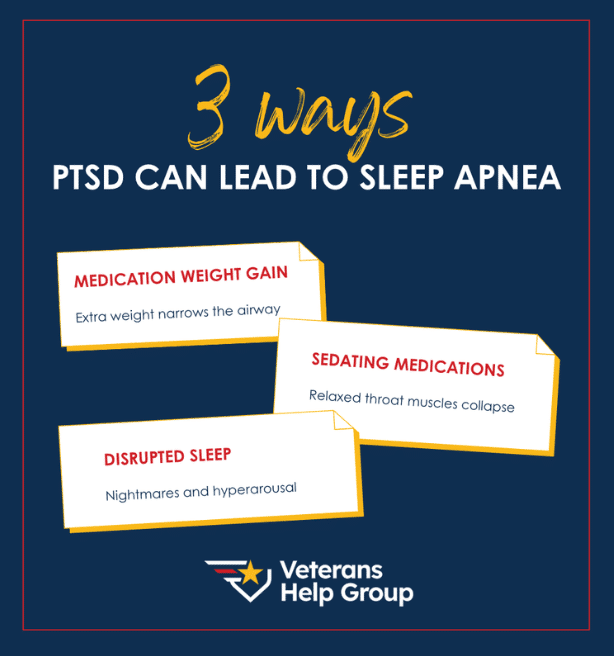
In practice, the strongest claims point to a specific way PTSD led to the sleep apnea. The most common ones:
- Medication weight gain. Some antidepressants and other psychiatric medications cause significant weight gain, and extra weight around the neck is a major risk factor for obstructive sleep apnea. If your weight went up after you started PTSD medication, your records can show it.
- Sedating medications. Some medications used for sleep or anxiety relax the muscles in your throat, which can make your airway more likely to collapse during sleep.
- Disrupted sleep and hyperarousal. Nightmares, frequent waking and a constant state of alert change how you breathe and sleep, which researchers believe can contribute to sleep apnea or make it worse.
There’s one more connection worth documenting. Many veterans with PTSD struggle to use a CPAP machine because the mask triggers claustrophobia, panic or flashbacks. If that’s you, tell your doctor and make sure it’s in your records. It can matter for your rating, especially if VA’s proposed rating changes go through (more on that below).
How to show your sleep apnea is secondary to your PTSD?
- Make sure to have a sleep study conducted and get a diagnosis for sleep apnea. VA requires a sleep study to confirm the diagnosis. A doctor’s note saying you have sleep apnea isn’t enough on its own.
- Your PTSD must already be service-connected. Even a 0% rating counts. If your PTSD claim is still pending, you can file for sleep apnea at the same time.
- Prove that your condition stems from your PTSD or from medication that you are prescribed for your PTSD. The most persuasive way you can show this is through an independent medical opinion (IMO). In an IMO, a doctor can explain to the VA why he or she believes that your sleep apnea was at least as likely as not a) caused or b) aggravated by your PTSD. IMOs can provide the VA with the information they need to grant your sleep apnea secondary service-connection.
A strong IMO doesn’t just say the two conditions are related. It names the specific pathway in your case, like weight gain after starting a particular medication, points to your records, and cites the medical research. VA examiners routinely reject opinions that only say “PTSD and sleep apnea are linked.”
Evidence That Strengthens Your Claim
- Your sleep study and sleep apnea diagnosis
- PTSD treatment records, including a list of medications and when you started each one
- Weight records over time, especially if they show gain after starting PTSD medication
- Notes about any trouble tolerating your CPAP
- Statements from a spouse or partner who has seen your snoring, gasping or stopped breathing at night
- An IMO or nexus letter, as described above
Expect VA to schedule a C&P exam. Bring your medication list and be honest about how your sleep, energy and CPAP use really are.
Other Ways to Connect Sleep Apnea to Service
PTSD isn’t the only path. Sleep apnea can also be secondary to other service-connected conditions, such as chronic sinus or nasal problems that block your airway.
And weight gain matters even when it isn’t from medication. VA doesn’t treat obesity as a disability by itself, but a 2020 court decision, Walsh v. Wilkie, confirmed that it can be an “intermediate step.” For example, if a service-connected back or knee condition left you unable to exercise, the resulting weight gain led to sleep apnea, and a doctor can connect those steps, you may have a valid secondary claim.
Sleep apnea is not a presumptive condition under the PACT Act, so it always needs this kind of evidence.
How VA Rates Sleep Apnea
Under VA’s current rules, sleep apnea is rated at:
- 0% for documented sleep apnea with no symptoms
- 30% for persistent daytime sleepiness
- 50% if you need a breathing device like a CPAP
- 100% for chronic respiratory failure, heart strain caused by the condition, or a tracheostomy
Your sleep apnea rating combines with your PTSD rating using VA math, not simple addition. A veteran rated 70% for PTSD who wins a 50% sleep apnea rating, for example, would combine to 85%, which rounds up to a 90% combined rating. You can run your own numbers with our 2026 VA disability calculator.
One thing VA won’t do is rate the same symptoms twice. Sleep problems like insomnia and nightmares are already part of your PTSD rating, so they usually can’t be rated separately. Sleep apnea is a different diagnosis, which is why it can be.
VA’s Proposed Sleep Apnea Rating Changes
VA has proposed rating sleep apnea based on how well treatment works, instead of whether you use a CPAP. Under the proposal, many veterans whose CPAP controls their symptoms would be rated lower than today’s 50%. Veterans who can’t tolerate treatment, including because of PTSD, could still qualify for higher ratings with the right medical evidence.
As of late September 2026, the change was not final. Veterans who already have a sleep apnea rating are generally protected, and claims decided before a new rule takes effect are rated under the current criteria. If you’ve been putting off a sleep apnea claim, now is the time to talk to an advocate.
How to File
If you’ve never filed for sleep apnea, file a new claim on VA Form 21-526EZ and list it as secondary to your PTSD. If VA already denied your sleep apnea claim, you’ll need a Supplemental Claim with new evidence, like an IMO you didn’t submit the first time. Either way, if you need time to gather evidence, submit an Intent to File first to lock in your effective date for up to a year.
If the information above seems overwhelming and you would prefer to have help from a VA-accredited advocate, Veterans Help Group has been helping veterans get the rating they deserve for over 20 years. Please contact us at 855-855-8992 or chat with us online for a free consultation.
Frequently Asked Questions
Is sleep apnea secondary to PTSD hard to win?
It can be. VA often denies these claims when the evidence doesn’t explain how PTSD led to the sleep apnea. A sleep study, clear medication and weight records, and a detailed nexus opinion make a big difference.
Can I get a 50% rating for sleep apnea if I can’t use my CPAP?
Under current rules, the 50% rating is based on needing a breathing device. If PTSD keeps you from tolerating it, make sure that’s documented. It’s especially important under VA’s proposed rating changes, which would look at whether treatment actually works for you.
Can I get a separate rating for insomnia from PTSD?
Usually not. Sleep problems are already part of how VA rates PTSD. Sleep apnea is a separate diagnosis, so it can be rated on its own.
Will VA’s proposed rating changes lower my current sleep apnea rating?
Generally no. Veterans who already have a sleep apnea rating are protected from automatic reductions when rating criteria change. The changes would mainly affect new claims decided after a final rule takes effect.
If the information above seems overwhelming and you would prefer to have legal help, Veterans Help Group has been helping veterans get the rating they deserve since 1995. Please contact us at 855-855-8992 or chat with us online for a free consultation.
Learn More About VA Disability Below:


Veterans Help Group’s Donnel Beckles Named Chief Operating Officer
Veterans Help Group's Donnel Beckles Named Chief Operating Officer Donnel Beckles finished law...

VA Rating Reductions: OIG Finds Errors in a Third of Cases
VA Rating Reductions: OIG Finds Errors in a Third of Cases The VA Office of Inspector General...

Are Disabled Veterans Eligible for TRICARE?
Are Disabled Veterans Eligible for TRICARE? Simply being a disabled veteran doesn’t necessarily...


