


Table Of Contents
Your Guide to VA Ratings: Sleep Apnea
Sleep apnea can be a serious condition that may impact day-to-day life and can increase the risk of serious medical issues such as hypertension, diabetes, and heart disease. Sleep apnea may be a service-connected condition for veterans disability benefits, or it may be secondary to a service-connected condition.
The VA recognizes three types of sleep apnea: obstructive, central, and mixed. All three are treated the same for disability rating purposes. Obstructive sleep apnea is the most common, and takes its name from the way the problem occurs: the muscles of the throat relax to the point that the flow of air is obstructed. Central sleep apnea, which is far less common, occurs when the brain fails to send the correct signals to regulate breathing. Finally, complex sleep apnea is a combination of the two. In some cases, central sleep apnea is triggered by treatment for obstructive sleep apnea.
About VA Disability Ratings
When the VA determines that you suffer from one or more service-connected conditions, they will assign a disability rating for each condition. Ratings are assigned in increments of 10, from 0% to 100%. If you have more than one service-connected condition, the VA uses a formula to combine the ratings for your various disabilities.
If you have a 60% VA disability rating for an unrelated condition and then receive a 30% disability rating for sleep apnea, that doesn’t mean you have a 90% disability rating. Instead, the 30% disability rating assigned for sleep apnea is applied to what’s left over after your existing disability rating. In this case, the veteran had a 60% rating for another condition, meaning 40% remaining to work with.
The 30% sleep apnea rating would be applied to that 40% (.30 x .40), which works out to .12, or 12%. That’s added to the 60% rating, for a total of 72%. However, since all disability ratings are in increments of 10, that will be rounded to the nearest 10–in this case, 70%.
VA Ratings for Sleep Apnea
Currently, 38 C.F.R. Part 4 provides for four possible disability ratings for sleep apnea:
| Rating | Criteria | 2026 Monthly Compensation |
|---|---|---|
| 0% | Diagnosed with the condition but not experiencing symptoms. | Not entitled to disability payments, but may qualify for other VA benefits (e.g. medical care) if income-qualified. |
| 30% | Suffers from “persistent daytime hypersomnolence” due to sleep apnea. | $552.47/month |
| 50% | Requires use of a breathing assistance device such as a CPAP machine. | $1,132.90/month |
| 100% | Chronic respiratory failure with carbon dioxide retention or cor pulmonale, or requires tracheostomy. | $3,938.58/month |
At every compensable rating (30% and up), veterans also qualify for other benefits such as no-cost medical care and prescriptions for service-connected disabilities; the 100% rating additionally includes healthcare and educational benefits for dependents.
Note, however, that the VA has proposed changes to the sleep apnea rating system. As of this writing, no final rule has been published, and current ratings remain in effect. If those changes take effect, they could mean lower disability ratings for veterans being rated after the change.
Proposed changes include:
- Creation of a 10% VA disability rating for sleep apnea when treatment is only partially effective
- Elimination of the 30% disability rating for those with persistent hypersomnolence
- A change in the criteria for the 50% rating, which would be available only to those for whom treatment was ineffective, or who could not tolerate treatment due to serious effects like organ damage
The change in the 50% rating criteria would eliminate the 50% disability rating for those who are dependent on a CPAP device or similar device due to sleep apnea.
Claiming VA Disability for Sleep Apnea? Timing Counts
The changes described above will put veterans seeking VA disability for sleep apnea in the future at a significant disadvantage, particularly those who must use CPAP devices to control their condition or those who suffer from chronic daytime sleepiness.
However, veterans who have already received a rating for sleep apnea when the change takes place will not lose their ratings. So, if you suffer from sleep apnea and have reason to believe it may be service-connected or secondarily connected to a service-connected condition, you’ll want to act quickly to file your claim. A VA-accredited disability benefits advocate can help.
Get Help with Your VA Disability Benefits Claim
Veterans disability benefits can provide important support for disabled veterans and their dependents. But, securing benefits and a fair disability rating can be a challenge.
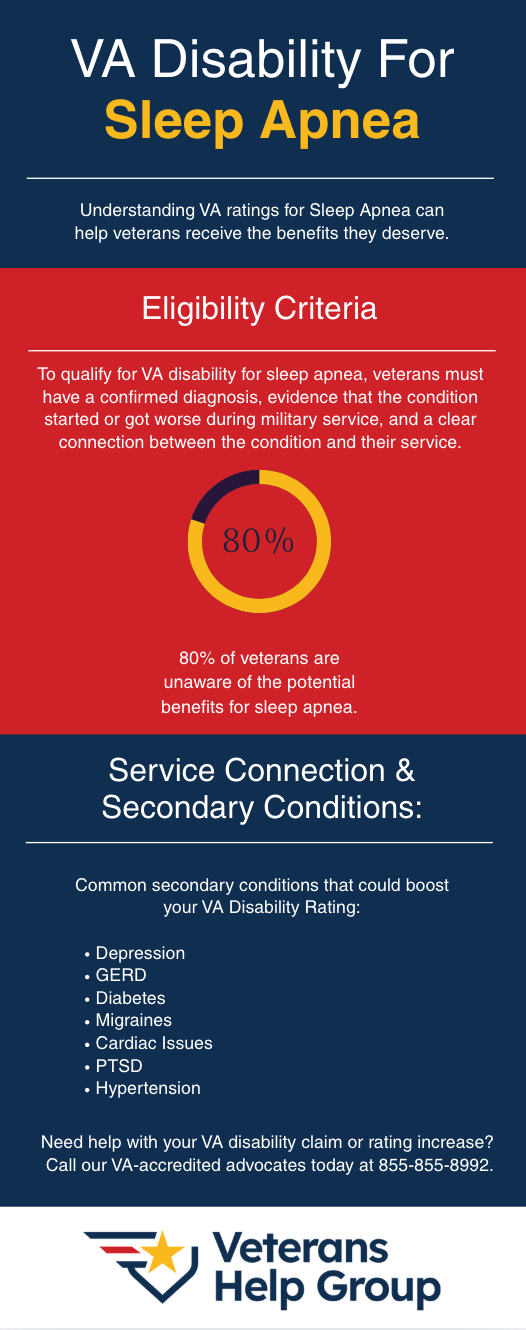
To be awarded benefits for sleep apnea, you will first have to present medical evidence that you have been diagnosed with sleep apnea. Then, it will be your responsibility to demonstrate that your sleep apnea is service-connected. Sleep apnea isn’t presumed service-connected, so this will typically require both evidence of the event that triggered your sleep apnea and medical evidence of the connection to your condition. Finally, it will be up to you to show that your symptoms fulfill the requirements for a particular disability rating.
At Veterans Help Group, our VA-accredited advocates have thorough knowledge of the disability claims and appeals processes and the type of evidence necessary to establish a claim. A veterans disability advocate can help you put together the strongest application and documentation possible, to increase the likelihood that your benefits will be approved at the maximum disability rating possible.
Veterans Help Group is here for you. To learn more, call 855-855-8992 or click here to fill out our contact form.
Frequently Asked Questions
Will my current sleep apnea rating be reduced when the proposed rule takes effect?
No. VA has stated that veterans already receiving compensation for sleep apnea are not affected by the proposed changes. If a final rule is later adopted, an existing rating cannot be reduced unless the evidence shows the veteran’s condition has actually improved.
Should I file my claim now, or wait for the new rule?
Since the current, more favorable criteria remain in effect and no effective date has been set for any change, veterans who believe they have a service-connected or secondary sleep apnea claim generally benefit from filing sooner rather than later.
Can I get a 100% rating for sleep apnea by itself, or do I need other conditions too?
Sleep apnea alone can reach a 100% rating under Diagnostic Code 6847 when it causes chronic respiratory failure with carbon dioxide retention or cor pulmonale, or requires a tracheostomy. No additional service-connected condition is required to reach that level.
Is sleep apnea automatically considered service-connected?
No. Sleep apnea is not on VA’s list of presumptive conditions. Veterans generally need to submit evidence connecting the diagnosis to an in-service event, injury, or exposure, or establish that the condition developed secondary to an already service-connected disability.
Can sleep apnea be service-connected as secondary to another condition, like PTSD?
Yes. Under 38 C.F.R. § 3.310, VA can grant service connection for a condition that is caused or aggravated by an already service-connected disability. The Board of Veterans’ Appeals has repeatedly granted service connection for sleep apnea as secondary to PTSD, based on medical opinions linking the two conditions. Other conditions commonly cited in secondary sleep apnea claims include diabetes, GERD, and service-connected musculoskeletal or respiratory conditions, but each claim still requires a medical nexus opinion connecting the two.
Learn More About VA Disability Below:


Female Sexual Arousal Disorder (FSAD) as a Secondary Condition to PTSD: What Women Veterans Should Know
Female Sexual Arousal Disorder (FSAD) as a Secondary Condition to PTSD: What Women Veterans Should...

Veterans Help Group’s Donnel Beckles Named Chief Operating Officer
Veterans Help Group's Donnel Beckles Named Chief Operating Officer Donnel Beckles finished law...

VA Rating Reductions: OIG Finds Errors in a Third of Cases
VA Rating Reductions: OIG Finds Errors in a Third of Cases The VA Office of Inspector General...


